
Haider Rasool, Barrister · 18 November 2026
Some of the hardest messages I receive come from people who were years into the 10-year route to settlement when their leave ran out. A missed email, an illness, a fee waiver that took too long. Suddenly they are told the clock has gone back to zero. In the last few weeks the Home Office has accepted, in a case brought in the Upper Tribunal, that it can look again at that kind of gap. Here is what the rules say, what has changed, and why it matters even more with earned settlement on the way.
What happens if my spouse visa expires in the UK before I apply?
If you apply to extend before your leave expires, your existing permission is extended by law while the application is decided, under section 3C of the Immigration Act 1971. You are not an overstayer while you wait.
If your leave runs out and no application has been made, you become an overstayer from the next day. On the 10-year partner, parent and private life routes, that matters a great deal. These routes depend on continuous residence, and the Home Office guidance is blunt: “Overstaying will break a person’s continuous residence unless certain circumstances apply.” In practice, many people who overstay are later granted permission again on family or private life grounds, but they start a new 10-year period from that grant.
Is there a 14-day rule for overstaying?
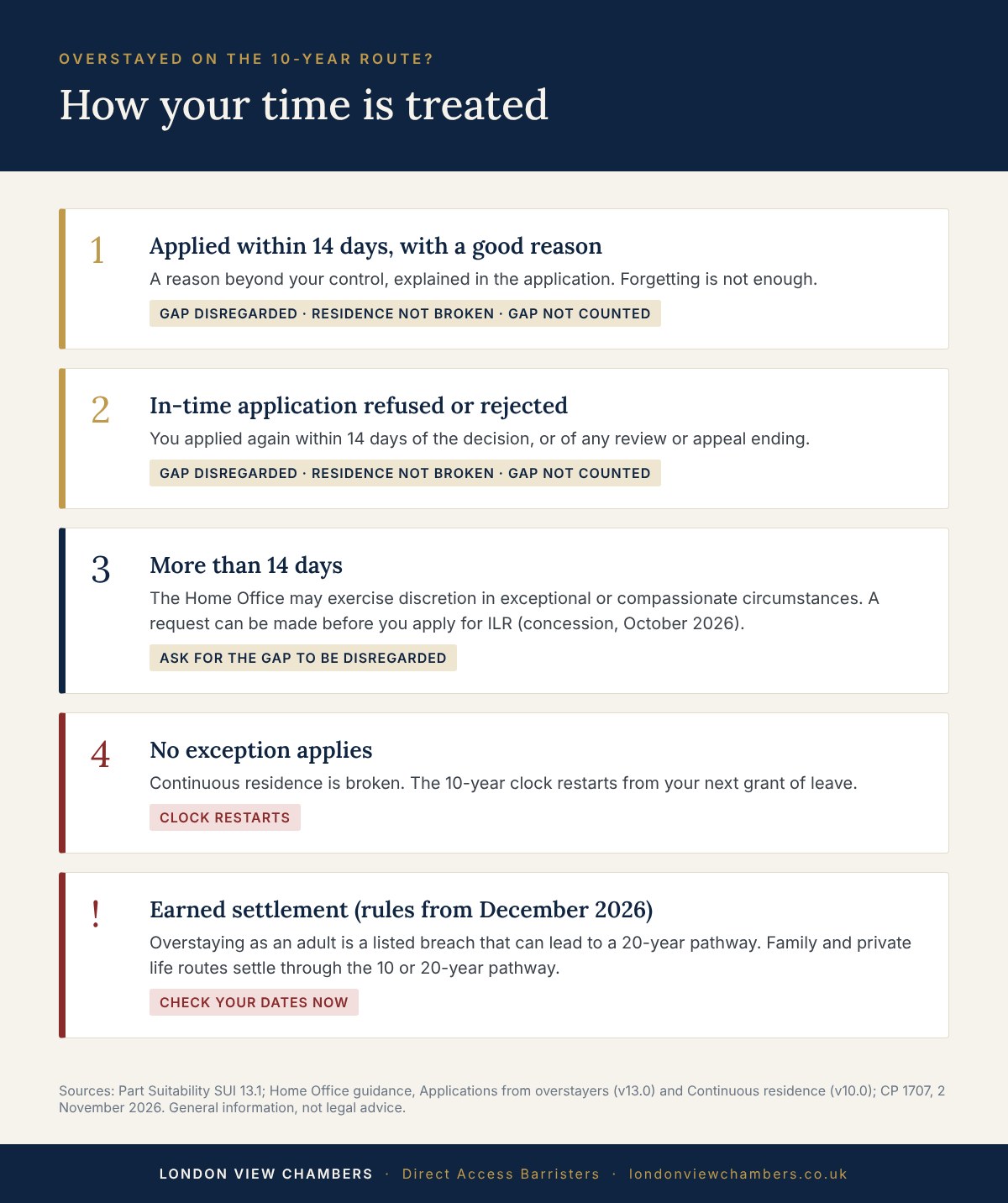
Yes, but it is narrower than most people think. The old paragraph 39E of the Immigration Rules now sits in Part Suitability as SUI 13.1. A short period of overstaying is disregarded in two main situations:
- You applied within 14 days of your leave expiring, and there was a good reason beyond your control, or your representative’s, why you could not apply in time. You must explain that reason in or with the application.
- You made an in-time application that was refused or rejected, and you applied again within 14 days of that decision, or of any administrative review or appeal ending.
The Home Office guidance gives examples of good reasons, such as emergency hospital admission or a close family bereavement, backed by evidence. It is equally clear that simply forgetting is not a good reason.
Even when the rule applies, the gap does not count. It stops the overstaying from breaking your continuous residence, but the days without permission are left out of the total. If you had a 10-day gap, you will need 10 extra days before you reach ten years.
I overstayed by more than 14 days. Is it too late?
Not necessarily. Outside the 14-day rule, the Home Office’s Applications from Overstayers guidance says caseworkers may exercise discretion “under exceptional or compassionate circumstances” where an application was made after the 14-day period. The example it gives is serious illness that prevented an application for longer than 14 days. Discretion has to be authorised by a more senior caseworker, and it is not given lightly. It does exist, though, and a well-evidenced request can succeed.
What does falling off the 10-year route mean?
It is the phrase people use when a gap in leave has restarted their 10-year clock. The consequences can be severe. Take the case that has just been conceded. The claimant, a Jamaican national who has lived here since 2000 and has a British daughter, had been on the 10-year route since 2016, with grants of 30 months in 2016 and 2019. In 2022 she missed an email confirming that her fee waiver had been granted, and so did not apply for further leave in time. She was an overstayer until 2024. When she was granted leave again in March 2024, her clock restarted. Her earliest date for indefinite leave to remain moved from around July 2028 to March 2034.
What has the Home Office now accepted?
She asked the Home Office to use its discretion to disregard the overstaying, so that her earlier years would still count. The Home Office refused, and then argued that it had no power to consider such a request at all until she made a paid application for indefinite leave. Shortly before the Upper Tribunal hearing listed for early November, it conceded the claim. The sealed order is dated 30 October 2026. The Home Office accepted that:
- it has discretion to disregard a period of overstaying on the 10-year route, even before a paid application for indefinite leave is made;
- its Applications from Overstayers policy applies to a request of this kind;
- the test is whether there are exceptional or compassionate circumstances, and the fact that the overstaying was unintentional must be taken into account;
- it will make a fresh decision within three months.
A concession is not a judgment, and it does not bind the Home Office in other cases. But it tells us the route exists and the test that will be applied. If you fell off the 10-year route years ago, you do not have to wait until you are applying for settlement to ask for the gap to be looked at again. You can ask now, and know where you stand.
Does overstaying affect the 10 year route to settlement under the new rules?
This is why the timing matters. Under earned settlement, the Government says that “specified immigration breaches committed as an adult will place an applicant on a 20-year pathway to settlement”. It names overstaying a visa as one of those breaches. It also says that Family and Private Life permission will not qualify anyone for the three or five-year pathways, so people on those routes will settle through the 10 or 20-year pathway.
The detailed rules have not yet been published. The Government has said they will begin to be laid from the December Immigration Rules and be implemented over 2027. We do not yet know whether a period of overstaying that has been disregarded will still count as a breach for this purpose. A disregard granted on solid evidence puts you in the strongest position whatever the final wording says. Breaches before the age of 18 will not count.
What should I do if I have a gap in my leave?
- Work out the exact dates: when each grant of leave ended, when each application was made, and what happened to it. Your decision letters and submission receipts are the key documents.
- Gather evidence of why the gap happened: medical records, emails, fee waiver correspondence, anything that shows it was not your choice.
- If your leave is about to expire, apply in time. Do not rely on the 14-day rule as a grace period. It is not one.
- If you have already fallen off the route, consider a written request now asking the Home Office to disregard the gap, setting out the exceptional or compassionate circumstances.
- Do not wait for the December rules to find out where you stand. If a request is refused, a refusal on these grounds can be challenged.
A final word
A gap in leave can feel like the end of years of effort. Often it is not, but the answer depends on the dates and the reasons, and both need to be set out properly. If you are on the 10-year route and something has gone wrong, or you simply want to check your dates before the rules change, get in touch. No question is too large or too small, and under Direct Access you can instruct a barrister directly, without going through a solicitor.
You may also find my earlier article useful: Earned settlement UK: the new ILR rules explained, plainly.
This article is general information, not legal advice.
Sources: Home Office, Applications from overstayers, version 13.0, 3 August 2026; Home Office, Continuous residence, version 10.0, 8 October 2026; A Fairer Pathway to Settlement: Government response to the consultation (CP 1707), 2 November 2026, pages 9 and 19 to 20; Doughty Street Chambers and GMIAU on the concession (sealed order 30 October 2026).
Fallen off the 10-year route?
Ask. No question is too small, and under Direct Access you can instruct a barrister directly, without a solicitor.