
Haider Rasool, Barrister · 8 November 2026 · Updated 22 November 2026
Of everyone affected by earned settlement, care workers have had the most anxious week. Many of the messages I have received are from carers who came to the UK between 2022 and 2025, did what was asked of them, and want to know one thing: will I still get ILR after five years? The Government’s response of 2 November 2026 gives care workers their own set of rules. This is what they say, in plain terms.
Care worker ILR new rules: what has changed?
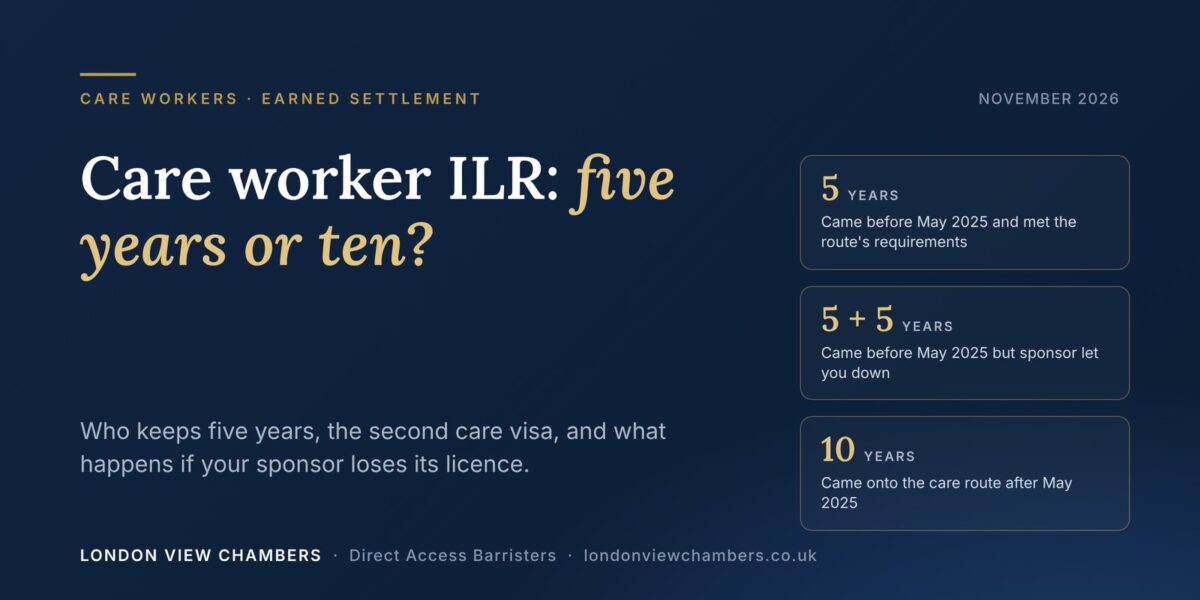
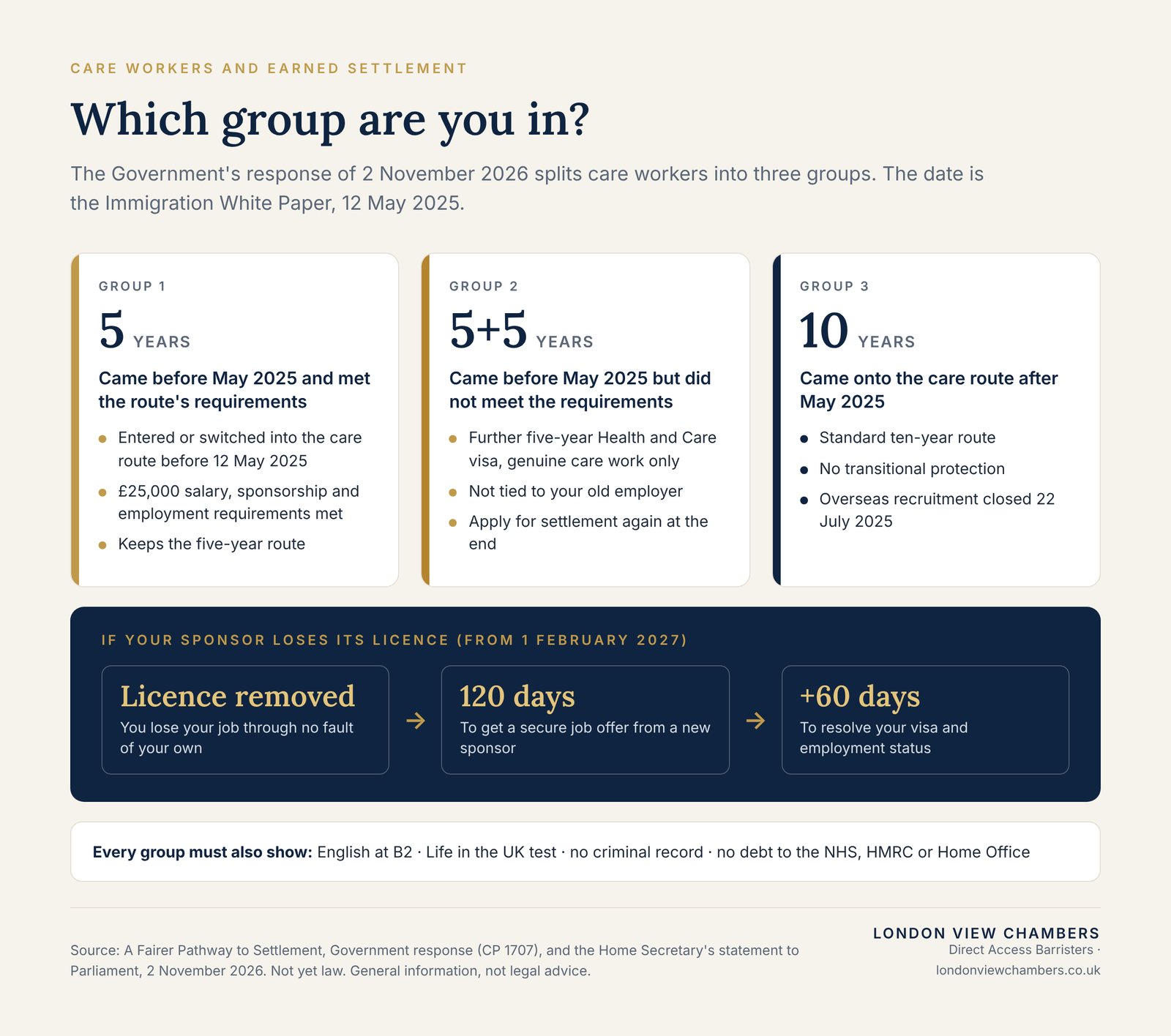
For most people, earned settlement moves the standard route to indefinite leave to remain (ILR) from five years to ten. Care workers on the Health and Care Worker visa are treated differently. The Government has divided them into three groups, depending on when they came onto the care route and whether they met its requirements. Which group you are in decides how long you wait.
I came before May 2025. Do I keep five years?
Yes, if you meet the requirements of your route. The cut-off is the publication of the Immigration White Paper on 12 May 2025. If you entered the UK as a care worker, or switched into the care route, before that date, and you meet the £25,000 salary, sponsorship and employment requirements, you keep a five-year path to settlement.
You will still need to meet the new requirements that apply to everyone: English at B2, the Life in the UK test, no criminal record and no debt to the state. Your five years are protected. The other conditions are not relaxed.
What if my sponsor never gave me the work or the pay?
This is the position of a very large number of care workers, often through no fault of their own. Some arrived to jobs that did not exist. Some were paid less than they were promised. Some saw their sponsor lose its licence. The Home Secretary told Parliament that this group is “around a quarter of those who came between 2022 and 2025”.
You will not be refused and sent home simply because you fall short at five years. You will be able to apply for a further five-year Health and Care visa, restricted to genuine work in the care sector. The Home Secretary said you “will not be tied to [your] old employer”, so you can move away from a bad sponsor. At the end of that visa you can apply for settlement again. You will have no recourse to public funds while on it.
Take, as an example, a carer who came in 2023 on a promise of £25,000 a year but was given too few hours and paid closer to £18,000. She cannot show the salary the five-year route needs. Under the new arrangements she can apply for the further five-year visa, move to a sponsor who pays properly, and apply to settle at the end of it.
In practice that means about ten years in total rather than five. It is not the outcome anyone hoped for, but it is far better than the refusal many people feared.
I came after May 2025. What happens to me?
You are on the standard ten-year route, with the same requirements as everyone else. The transitional arrangements apply only to those who joined before the White Paper. Bear in mind too that the care worker route closed to new applicants from overseas on 22 July 2025. Some people already in the UK can still switch into it until July 2028, but only if they have already worked for the sponsoring care provider for at least three months.
Care worker sponsor licence revoked: how long do I have?
This is where the most practical change is, so it is worth being precise about what happens now and what is coming.
For most Skilled Workers, when a sponsor’s licence is revoked the Home Office will usually cut the visa short to 60 days, or to its original expiry date if that is sooner. Care workers are now treated differently. Since 11 September 2026, Home Office guidance has told caseworkers not to cancel the visa of a care worker or senior care worker (occupation codes 6135, 6136, 6145 and 6146) where the only reason would be that the sponsor’s licence has been revoked. So a care worker whose employer loses its licence should not, for that reason alone, receive a 60-day curtailment letter.
That protection has limits. The Home Office describes it as temporary and under regular review. It does not help if there is any other reason to cancel your visa, for example if the Home Office says you were involved in your employer’s failings. And your sponsored job still ends when the licence goes, so you still need a new licensed sponsor and a new visa application before your current visa runs out. I have set out the steps in a separate article: Sponsor licence revoked: what happens next for your visa.
From 1 February 2027, care workers who lose their job because their sponsor’s licence has been removed will have up to 120 days to get a secure job offer, and a further 60 days to resolve their visa and employment status. That is up to 180 days in total, three times the standard 60 days. The Government says it will also “continue to work with the care worker to help them find a new employer”. If you cannot find a job offer within 120 days, or sort out your status within 180, your visa will be curtailed and you will need to leave the UK.
Three things the Government’s document does not yet make clear. It does not say whether the longer period applies to every care worker or only to those who came before May 2025. It says nothing about dependants. And it does not extend the longer period to Skilled Workers outside the care sector. The December rules should answer these points.
Two pieces of advice. First, the time you have already spent here is not lost when your sponsor’s licence goes: time with one sponsor and time with the next both count towards ILR, as long as there is no gap in your leave. Second, do not let your visa run out while you look. Overstaying is one of the breaches the Government says can put you on a twenty-year route under earned settlement. If your sponsor is under investigation or has had its licence suspended, start looking for a new employer now.
Care worker ILR requirements: what will I need to show?
- Five years on the care route (or about ten if you are in the second group).
- The £25,000 salary, sponsorship and employment requirements, with payslips and P60s to prove them.
- English at B2.
- A pass in the Life in the UK test.
- No criminal record, which now includes cautions and conditional discharges.
- No unpaid NHS charges, tax or other debt to the Government.
Care visa dependants: will my family settle with me?
The general rule in the Government’s response is that a partner who came with you can settle at the same time as you, provided they meet the requirements themselves. Children under 18 settle with you and are exempt from the income, English, debt and Life in the UK requirements. A partner who joined later must complete their own qualifying period.
There is one question the December rules will need to answer. The basic earnings requirement for a couple is £25,142 a year between you, while the protected care salary is £25,000. On the figures as announced, a care worker on exactly £25,000 whose partner does not work would be £142 short of the couple figure. The Government has not said how the two rules fit together for the protected care group. If this is you, it is worth watching for the detail, and any part-time earnings by your partner would close the gap.
Care worker ILR update: is it law yet?
Not yet. What was published on 2 November is the Government’s final policy. The Home Secretary said the changes will begin to be laid from the December Immigration Rules and be implemented over the course of 2027. Until then, applications are decided under the current rules. I will write again when the December Statement of Changes is published.
What should care workers do now?
- Gather your evidence for every year: payslips, P60s, your contract and your Certificate of Sponsorship. Proof of £25,000 and genuine employment is what secures the five-year route.
- If you are eligible for settlement now under the current rules, apply before they change. Do not apply early: an application made before you qualify will be refused.
- If your sponsor has not paid you properly or given you the work, get advice now so you know which group you are in.
- If your English certificate is B1, book a B2 test.
- Clear any NHS or other Government debt.
A final word
Many care workers came to the UK in good faith and were badly let down by the people who sponsored them. The new rules are tougher, but for most care workers who came before May 2025 they are not the end of the road. If you are unsure which group you are in, or your sponsor has left you in a difficult position, get in touch. No question is too small, and under Direct Access you can instruct me directly without going through a solicitor.
You may also find my other articles useful: Earned settlement UK: the new ILR rules explained, plainly and Sponsor licence revoked: what happens next for your visa.
This article is general information based on the Government’s announcement of 2 November 2026 and Home Office guidance as at 22 November 2026. It is not legal advice. Your position depends on your own circumstances.
Sources: A Fairer Pathway to Settlement: Government response to the consultation (CP 1707), GOV.UK, 2 November 2026, pages 38 to 41; Home Secretary’s oral statement to the House of Commons, 2 November 2026; Home Office, Cancellation and curtailment of permission, version 12.0 (11 September 2026).
Not sure which group you are in?
Send a short message below and we will reply by email. Under Direct Access you can instruct a barrister directly, without a solicitor. An initial consultation by phone or video is a fixed fee of between £200 and £450, agreed with you before it takes place. See our fees.